Rainfall art, a gift for a farmer
A year of rain and snow on the farm, or back home, printed for the wall
A framed print of the farm’s year of rain, from the gauge nearest it. Type a town and a year, and I draw every rain and snow the nearest weather station caught. A gift for a farmer, or for the year you married or a child was born. Drawing it is free.
$89 framed$45 print$19 digital fileShipping included


Type the town nearest the farm and press Draw my year.
Where and when
In Canada? Type the town and province, like Regina, SK, or a postal code. Au Canada? La ville et la province, par exemple Saint-Hyacinthe, QC.
Print files for fulfillment. The 13 x 19 in sheet at 300 dpi, landscape, untrimmed: the picture 16.5 x 11 in in the middle, white all round, every word inside the mat’s window. Add &serial=N to this page’s link and the print files carry "No. 000N" under the QR (initial each physical print beside it in pencil); &serial=0 gives "No. 0000" for your own test prints, with the real QR; the digital file and the SVG never do. The SVG is for viewing in a browser; print from the PNG or PDF. Test print PDF (standard code) is for your own test prints and samples: its QR opens the Rain Print page, not this design, and it needs no short link. Never send it as an order. This box opens only on a browser that has opened this page once with ?maker= and Sig’s key; ?maker=1 anywhere else shows the public page. It keeps casual visitors out. It does not protect the files from anyone who reads the page’s code.
Insert letter: one 8.5 x 11 page that goes on top in the box of every print and framed print (not the digital file). It lies flat on the print. Its numbers are the print’s own, it carries the serial from &serial=N (a blank to fill in by hand without it) and the standard code. Paste the gift note or the business’s message from the order below; leave it empty and the letter has no note.
Reading guide: one 8.5 x 11 page, How to read your Rain Print, that goes with a digital file (the files email sends it with the PNG, PDF and JPG the moment the buyer approves the proof). The letter’s numbers and key, plus a line for each extra the print draws; no serial and no code line. The note above goes on it too.
Your words (all optional)
0 of 24 letters
0 of 70 letters
Emoji and symbols aren’t in the print’s typeface, so they were left out. Letters, numbers and everyday punctuation print as typed.
Mark a day (up to 5)
0 of 13 letters
0 of 13 letters
0 of 13 letters
0 of 13 letters
0 of 13 letters
5 days is the most that fits. Remove one to mark another.
Or tap one:
More options: compare, station, normals, remarkable days, crop, temperatures, history, logo
Nothing: just your year. NOAA normal: a usual year by NOAA’s 30-year normal. Full record: this station’s own average over every year it has kept.
Rain and snow: it keeps a snowfall record too, so snow can show on the print. Rain only: no snow on the print. Any station here can make it.
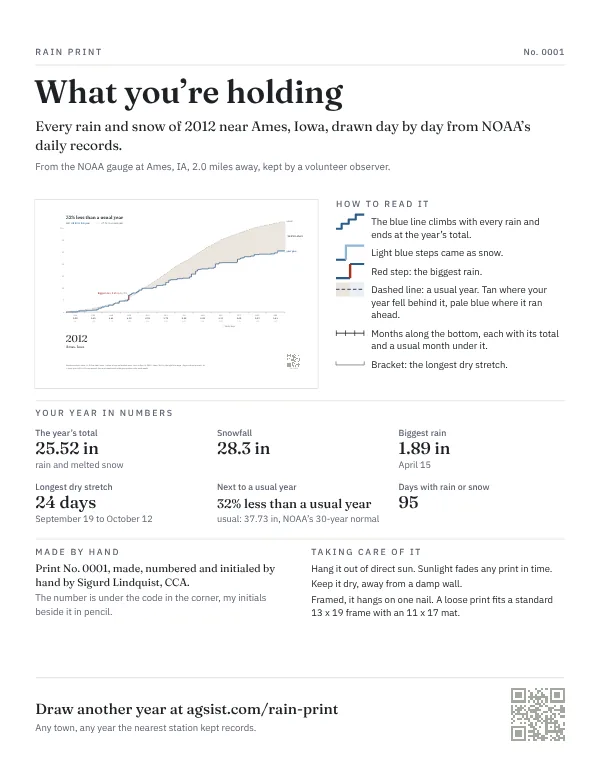
Staircase steps up with every rain, so a flat stretch is a dry stretch and a tall step is a big rain. Roots draws each day as its own line, snow stacked above the ground and rain soaking down below it. The normals show NOAA’s 30-year normal for each month under its total. Remarkable days marks the biggest snow, the wettest week, and any month or year that stands out in that station’s own history, if it has kept records long enough to tell.
Your farm or business logo. It prints small, next to the name. A big, clear file prints best. PNG, JPG, WebP or SVG, up to 10 MB. Only a logo you own or have permission to use. Your logo is stored on AGSIST’s server so the print can use it.
The year in numbers
How do you want it?
A 2026 print for Christmas
A 2026 print ships in January 2027, once the full year is in. Every order gets a proof by email first.
Want a gift card for under the tree? Fill in the boxes above, then order. Within 1 business day of paying, I email you a card to print, with a code they use to see their print.
What you get
Framed
- Shipping included, anywhere in the 50 states
- A 13 x 19 black frame with a white mat, ready to hang
- Real glass front, packed with corner guards and foam, double-boxed
- Numbered, and initialed by hand in pencil
- Shipping included, anywhere in the 50 states
- I print it myself, and you see a proof first
- Numbered, and initialed by hand in pencil
- Printed on 13 x 19 in heavy, textured cotton fine-art paper; fits a standard 13 x 19 frame with an 11 x 17 mat
- Ships flat between chipboard
Digital file
- A PDF, a PNG and a JPG of the picture alone, 12 x 18 in at 300 dpi, no watermark; it fits a 12 x 18 frame
- A one-page guide to reading it, and tips for printing it
- A proof by email within 1 business day of paying, the full file once you approve it
- Take it to any print shop
- Want a change after? Write to me and I’ll redo it.
Keep a print out of direct sun; the inks fade in strong light.
A gift? On the next screen, before you pay, tick This is a gift and add their name and your note; Stripe asks where to ship it. I print your note at the top of the letter in the box, free, and no prices go in the box.
You see a proof first, and get a full refund any time before I print.
Made by Sig Lindquist in Chetek, Wisconsin. Your proof comes by email from Sig, your receipt from Stripe.
There’s no name on it yet.
Questions? Call or text Sig at 715-797-2428, or write to sig@farmers1st.com.

It’s a gift? Say so on the order form, with their name and your note.
Prints and framed prints ship within 3 business days after you approve the proof, anywhere in the 50 states.
Design code:
Order request
I’ll email you within 1 business day with a payment link, and a proof first for a print. Nothing’s charged until you pay it.
Real prints, in the two styles
Two of my test prints, both of Chetek, Wisconsin, framed in black. They are shown without the white mat that comes with a framed print.

After you order
- You pay at checkout. Your design goes with the payment, so I know exactly which print is yours. Shipping is in the price.
- Every order gets a proof by email. Within 1 business day of paying (for this year’s gift print, in January): a picture of your design and, for a print, the letter that goes in the box. Tap Approve this print in that email, or Ask for a change. Nothing prints until you approve it. A digital file comes by email within minutes of your OK: a PDF, a PNG and a JPG, with a one-page guide to reading it. Want anything changed after that? Write to me and I’ll fix it or redo it by hand, no charge.
- I print it and ship it. I print it myself, frame it if you ordered the frame, and ship it from Chetek, Wisconsin. A digital file comes by email instead.
I print each one myself in Chetek, Wisconsin, and send you a proof first. Sig
What’s in the box
- The print, flat between chipboard, or the framed print, packed with corner guards and foam and double-boxed.
- A letter on top, so whoever opens it knows what it is before they see it: where the rain came from, how to read the print, and the year in numbers, the same ones the print shows, with its serial number.
- Your note, printed at the top of the letter, when it’s a gift. A business’s message goes there too. There’s no separate card.
- No prices go in the box. The digital file comes by email, so there’s no box.
Which year to pick
If it’s a gift, for Christmas, a retirement or an anniversary, the year usually picks itself:
- The drought, when the gauge sat empty for weeks
- The flood, or the spring you couldn’t get in the field
- The first crop on new ground
- The year the farm changed hands
- A mom’s or dad’s last crop
- The year you got married
- The last year before retiring
Other gift ideas for a farmer, from bibs to a meal for the harvest crew: gifts for farmers.
Ordering 5 or more for customers?Elevators, co-ops, ag lenders, seed dealers. Prices drop from 10 prints.Get a quote
For businesses
For elevators, co-ops, ag lenders, seed dealers and land auction companies that give customers something in December. Each print can be a different customer’s town and year, or the same town for the whole set. Business orders start at 5 prints: 5 to 9 prints cost the regular price, on one invoice, and 10 or more cost less per print. Every price includes shipping. For fewer than 5, order the regular way.
- Send me the list: how many, which product, and the towns and years. If it’s one town for all of them, just say so.
- I email back a quote and one proof sheet with every print on it.
- Once you OK the proof sheet, I print them, frame them if you ordered frames, and ship them, all to one address or one to each customer.
The full business page, with the price table, a customer list template and Christmas dates: Rain Print for businesses.
Your business’s name does not go on the print, so it hangs in the house, not the shop. If you want your logo on it, upload one with your request: it prints small, next to the name, and you see it on the proof sheet first. Your message is printed at the top of the letter in the box, and on a label on the back of the frame if you want one, at no charge. I can ship straight to each of your customers. No prices go in the box.
A 2026 print ships in January, once the full year’s numbers are in. Past years ship before Christmas if the list comes in time.
Paperwork: an invoice, net 30, and a W-9 on request.
Ask for a quote
Nothing is printed or charged until you OK the quote and the proof sheet. Or email the list to sig@farmers1st.com.
Questions
Where does the rain data come from?
From the nearest weather station with a good record for that year, from NOAA’s daily records. Some are National Weather Service stations, some are rain gauges kept by volunteers; the line under the picture says which. The print names the station and how far it is from town, in a small line at the bottom. It’s that station’s gauge, so a storm that hit the farm and missed the station won’t show. If there’s a station closer to the farm, pick it under Weather station, in More options.
What does “a usual year” mean?
When you compare with NOAA’s 30-year normal, a usual year is that normal for the station. When you compare with the station’s full record, it’s the station’s own average over every year it has kept. Either way, a day the station didn’t report is left out of both totals. The print says which one it used.
What if the station missed days?
Missing days show as gaps, never as dry days, and a small line on the print says what a gap is. The page reads the three nearest stations and picks the first with 10 or fewer missing days. A station missing 11 to 31 days can still be drawn, and the line under the print says how many. A station missing more than 31 days in the year gets no print, because the gaps would look like dry weeks that may not have been dry. A morning reading is filed under the day it was read, so an evening storm can show on the next day.
Does it show snow?
Yes, where the station kept a snowfall record nearly every day. Snow is drawn above the line, never below it, and looks different from rain, so you can tell a snow day from a rain at a glance. If the station didn’t keep snowfall, the snow is still counted, melted down to water the way the gauge measures it, but it can’t be drawn as snow. The year in numbers, under More options, says which.
How are the crop stages placed?
Mark the planting day and the harvest day, then pick corn or soybeans under More options. Each stage goes on the day the growing degree days at the station reached it, counted from planting the same way as the GDU calculator: each day’s high and low held between 50°F and 86°F, averaged, less 50. Corn stages use Purdue’s NCH-40 numbers for a 2,700 GDU hybrid. Soybeans show emergence and V3 only: their flowering and maturity depend on day length and variety, so they are not drawn. A day with no temperature reading stops the count, and no later stage is claimed. Compare with a usual year runs the same crop on NOAA’s 1991 to 2020 normal temperatures and says how many days ahead or behind silking (corn) or V3 (soybeans) came.
Where do the frost dates and temperatures come from?
From the nearest weather station that kept daily highs and lows that year, often the same one as the rain; the print names it. Frost is a low of 32°F or colder: the last one before August and the first one after July get a small mark on the date line. If a missing reading could hide a later or earlier frost, that frost is left off. The hottest and coldest day go in the small print. Daily temperatures adds a thin band under the chart with each day’s high and low; a day with no reading is a gap.
What are the gray lines behind the year?
That’s the Every year behind your year option. Each gray line is another full year the station kept, every day reported, drawn the same way as yours, with your year in blue on top. The two wettest and two driest of them have their year written at the end of the line, and the print says where your year ranks. It needs at least 30 full years, so the print uses the nearest station with that long a record, which may be a few miles farther, and names it. Staircase only.
Can I see the year’s total for free?
Yes. Drawing it is free and so are the numbers. Once your year is drawn, open More options, then The year in numbers. It shows the year’s rain and melted snow, the snowfall, the wettest day, the longest dry stretch and, if you pick something to compare with, a usual year’s total. You only pay if you want the print. For rain so far this year in every county, see the county link at the bottom of this page.
Can I give this year’s print for Christmas?
Yes. Pick this year in the Year box and order at the regular price. Within 1 business day of paying, I email you a gift card to print for under the tree, with their name, your message and a code they use to see their print. I make the full-year print once the full year is in and send it in January, with a proof to you first. A digital file comes finished in January instead, and I’ll redo it if you want a change.
Can you ship it straight to them with a note?
Yes. Before you pay, tick This is a gift and give their name and your note, then their address at checkout. I ship the print with your note printed at the top of the letter in the box, at no charge. No prices go in the box.
What comes in the box?
The print ships flat between chipboard; the framed print is packed with corner guards and foam and double-boxed. On top is a one-page letter, so whoever opens it knows what it is: where the rain came from, how to read the print, and the year in numbers, the same ones the print shows, with its serial number. If it’s a gift, your note is printed at the top of that letter. No prices go in the box. The digital file comes by email, so there’s no box.
Can I order more than one?
Yes. Make one and pay for it. When checkout brings you back here, tap Make another for someone else: the town, year and style stay and the words clear for the next one. Or change the town or the year: one for each of the kids, or one for the home farm and one for the rented ground. Each gets its own proof, and shipping is included in each. Ordering 5 or more for a business? See For businesses above.
Can I make one for our wedding year or the year a child was born?
Yes. Pick the year, anywhere back to 1890 if the station kept records that long, and mark the day itself under Mark a day. You can mark up to 5 days, so the wedding, a birthday and the year’s first harvest can all go on one print. Put the names on the name line and a few words on the line under it.
Is it a good gift for a farmer who has everything?
That’s who I make it for. They already have the boots and the pocketknife. They don’t have the year they still talk about, the drought or the wet spring or the year they bought the place, drawn day by day from the gauge nearest the farm and framed to hang. The order-by date for Christmas is on each choice when you order.
How big is it?
It’s printed on 13 x 19 inch heavy, textured cotton fine-art paper, hung sideways, with the picture 16.5 x 11 inches in the middle and white all around it. It fits a standard 13 x 19 frame with an 11 x 17 mat. The framed one comes in a 13 x 19 black frame with a white mat and a real glass front, ready to hang. Every print I make is numbered, and I initial each one by hand in pencil.
When will it arrive?
Prints and framed prints ship within 3 business days after you approve the proof, anywhere in the 50 states, Alaska and Hawaii included, and shipping is included in the price. To have a past year by Christmas, anywhere in the 50 states, order by the date shown with your choice: it allows a day for the proof, a day for you to OK it, 3 business days to ship and the time in the mail. The digital file gets a proof by email too; the files come by email within minutes of your OK.
Can a business order a set?
Yes, from 5 prints, each with its own town and year if you like. Every price includes shipping. 5 to 9 prints cost the regular price, on one invoice. 10 to 24 are $40 a print or $79 framed; 25 to 49, $37 or $75; 50 to 100, $35 or $72. From 10 prints, all to one address takes $3 off each print and $6 off each framed. Over 100, ask me. Your message is printed at the top of the letter in the box, not on the print. Your business name stays off the print too; a logo can go on it, small next to the name, if you upload one. Invoice, net 30, W-9 on request.
What if something’s wrong with it?
A print or framed print waits for your OK on the proof, so check the spelling there. If I print something different from the proof you OK’d, I’ll reprint it free. The digital file waits for your OK on the proof too, so check the spelling there; after that, if you want anything changed, write to me and I’ll fix it or redo it by hand and send it again, no charge. If it arrives damaged, glass included, send a photo. If tracking shows it lost, write to me. Either way I’ll reprint or reframe it free, with the same serial number. If you change your mind before I print, I’ll refund you in full. Once it’s printed with your name and dates, I can’t take it back, but I’ll make it right if something’s wrong. For a gift print of this year, if the station ends up missing too many days, I’ll use the next nearest station with your OK, or refund you in full. Write to me at sig@farmers1st.com.
What is the small square in the corner?
My maker’s mark. It’s also a working QR code. On your finished print, it opens your print’s own page, with the same place, year, style, name and dates. On the preview here, it opens the Rain Print page.
How much rain has your county had this year? See every county. Rain on one field this week? Radar rain on your field.
Also in the works: a better rain gauge.