US Drought Monitor
NDMC’s share of the Lower 48 in drought shows here after each Thursday read. The map below is this week’s.
This week’s map, your county’s numbers, and what each category means for crops.
The drought numbers are NDMC’s.
Is your county in drought this week?
This week’s share in each category, how long it has run, rain this year and the record since 2000. NDMC county numbers and the county’s rain gauge.
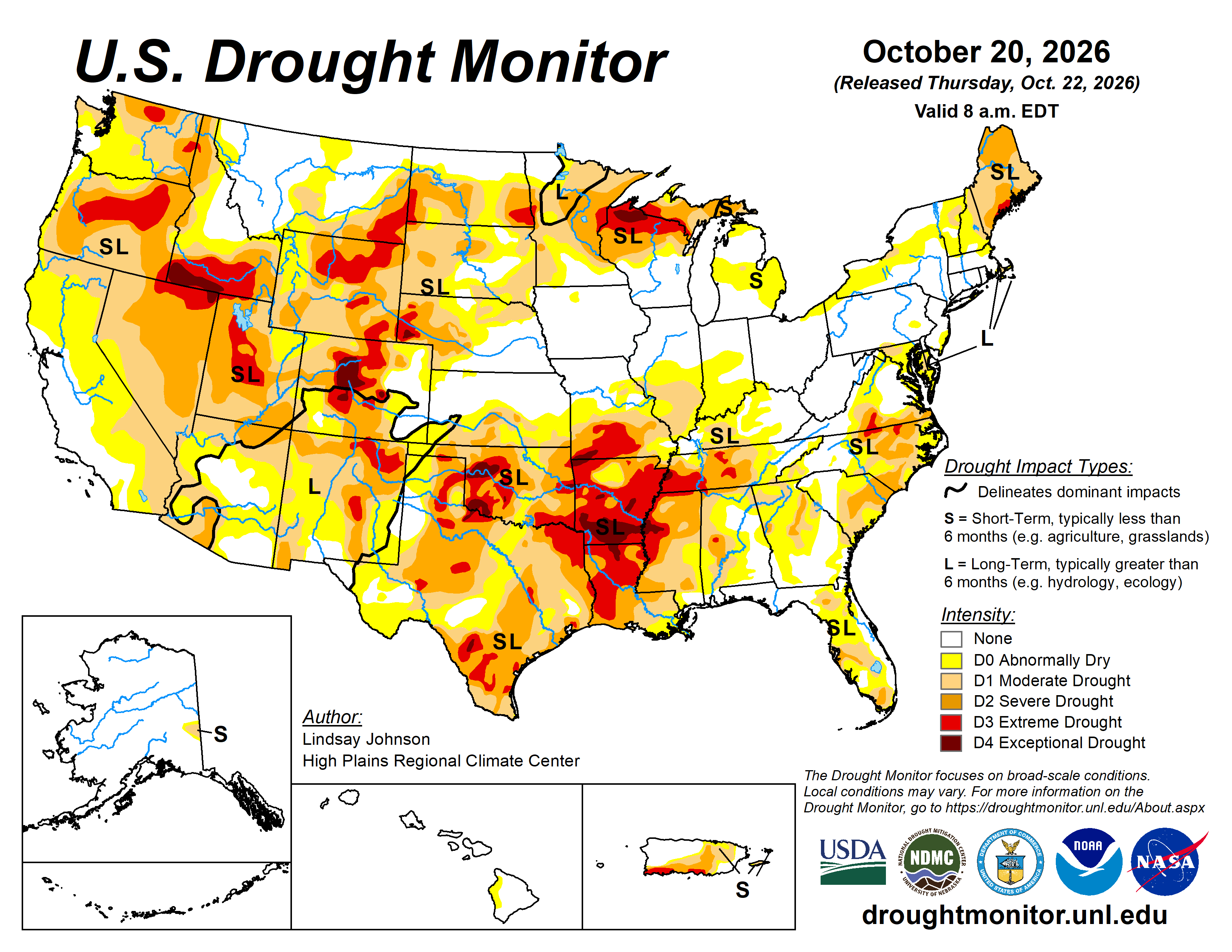
The drought map image did not load.
See the current map at droughtmonitor.unl.edu.
My rule of thumb as a crop adviser, not an NDMC rating. Soil, rooting depth and stored moisture move these a lot.
| Crop | Critical Period | Drought Risk | What's at Stake |
|---|---|---|---|
| Corn | Late July – August | D1+ = High risk | Pollination failure; grain fill stunted. Stress at silking costs more yield than at any other stage. |
| Corn | June (early growth) | D2+ = Moderate risk | Root development impaired; plants stress before they can show it. |
| Soybeans | Late July – September | D1+ = High risk | Pod set and seed fill, most water-sensitive stage. Yield loss compounds quickly. |
| Winter Wheat | Fall establishment & spring green-up | D1+ = Moderate risk | Poor tiller development; winter kill risk increases on shallow soils. |
| Hay / Pasture | May – August | D0+ = Risk begins | First cutting reduced; recovery slows. Supplemental feed costs escalate at D2. |
What comes next: NOAA’s rain outlooks
NOAA Climate Prediction Center odds of more or less rain than normal, for next month and the next three months. Green leans wet, brown leans dry; white is equal chances. Copies AGSIST saves when CPC issues them (third Thursday of the month).
Release Schedule
Published every Thursday by 8:30 AM ET. The map reflects conditions through the preceding Tuesday. The national map here is a copy AGSIST saves after each release, labeled with its valid date.
USDA programs and the drought map
Different USDA programs respond to drought in different ways. LFP (Livestock Forage Disaster Program) is tied directly to the USDM: FSA counts weeks with any part of the county in D2, D3 or D4 during the county's normal grazing period (the rule is 7 CFR part 1416). The county box on this page counts those weeks for any county. PRF (Pasture/Rangeland/Forage) is a rainfall-index product and does not use USDM categories. It pays when the grid's rainfall index for an insured interval falls below the coverage level the producer picks, 70% to 90% of normal. See what PRF would have paid on your grid, every year since 1951. WFRP (Whole-Farm Revenue Protection) pays when year-end revenue falls below your insured revenue from any covered cause, not on USDM status. NDMC keeps an LFP drought page for FSA by county.
Regional drought patterns
The western Corn Belt (Iowa, Nebraska, Kansas, South Dakota) and Southern Plains see drought most frequently. Sandy soils drain fast and show stress first in any region. Check your county on the state view and watch the CPC outlook for 1–3 month trend.
Basis Impact
A local drought means fewer bushels coming in, and elevators may bid basis up to get them. A drought rally in futures can pull the other way. Watch both on the Cash Bids page.
Common questions
Is my county in drought this week?
How does drought affect corn and soybean yields?
What is D2 drought and what does it mean for farmers?
When is the US Drought Monitor updated?
Does drought monitor status affect crop insurance?
Which states are most affected by drought in the Corn Belt?
How many weeks does my county have to be in D2 before LFP kicks in?
What's the most LFP will pay me in a year?
Does grazing corn stalks count for LFP if we're in drought?
Made by Sigurd Lindquist, CCA, Chetek, Wisconsin.