Tar spot of corn: what to look for, and when a spray pays
Sources named in each section and listed at the end. Checked November 5, 2026.
Tar spot is a leaf disease of corn. University loss estimates put it in the hundreds of millions of bushels in its worst years. The short version: pick a hybrid that holds up, scout before tassel, confirm what you find, and spray when disease, crop stage and weather line up. A pass has to save enough bushels to cover its own cost, and a second pass has to earn its own way.
- Where it is
- Identify it
- Scouting
- Weather risk
- When to spray
- Break-even
- Product ratings
- Harvest and silage
- Myths
- Questions
What it is and where it is now
Tar spot is caused by the fungus Phyllachora maydis. It survives the winter on infected corn residue, and its spores move by rain splash and wind. It grows only on living leaf tissue, and badly hit fields lose green leaf early, which cuts grain fill short.
It was first confirmed in the United States in 2015, in Indiana and Illinois (first report, Ruhl and others, 2016). Since then it has been confirmed across much of the Corn Belt and beyond. University reports name Maryland's first find in 2022 (Harford County, University of Maryland Extension), nine North Dakota counties in 2024 (North Dakota State University, October 2024) and North Carolina's first case, in Randolph County, in 2026 (NC State Extension, August 31, 2026).
How much it costs depends on the year. University disease loss estimates put the US loss to tar spot at about 231 million bushels in 2021, 38 million in 2023 and 293 million in 2024 (Crop Protection Network loss estimates, US only, not Ontario). These are expert survey estimates, not measured losses. The 2025 estimate stayed concentrated in the northern states. We have not seen a 2026 estimate yet.
The Crop Protection Network keeps the county map of confirmed finds for the current year. A county with no find on that map is not a clean county: the map records where someone looked, found it and reported it. A find in your county does not mean your field needs a spray either.
How to identify it
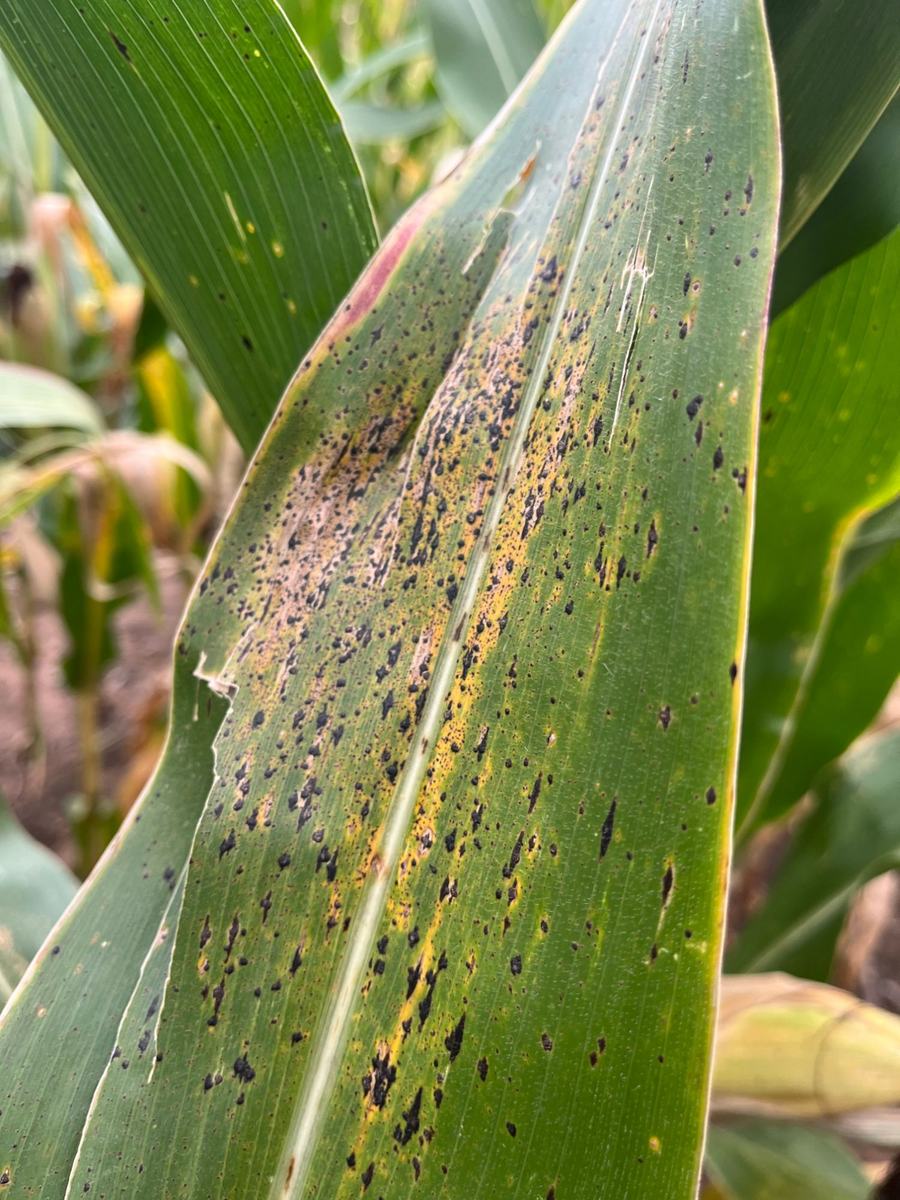
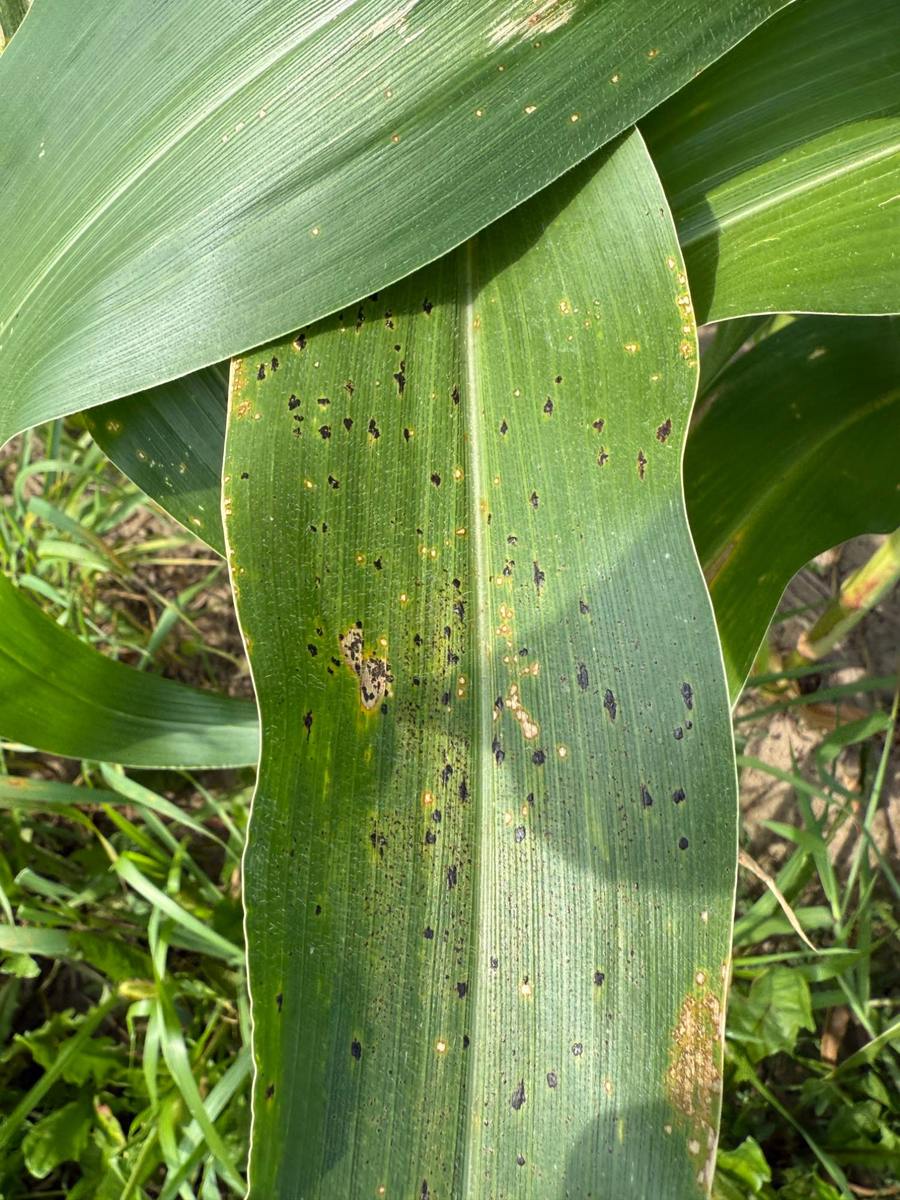
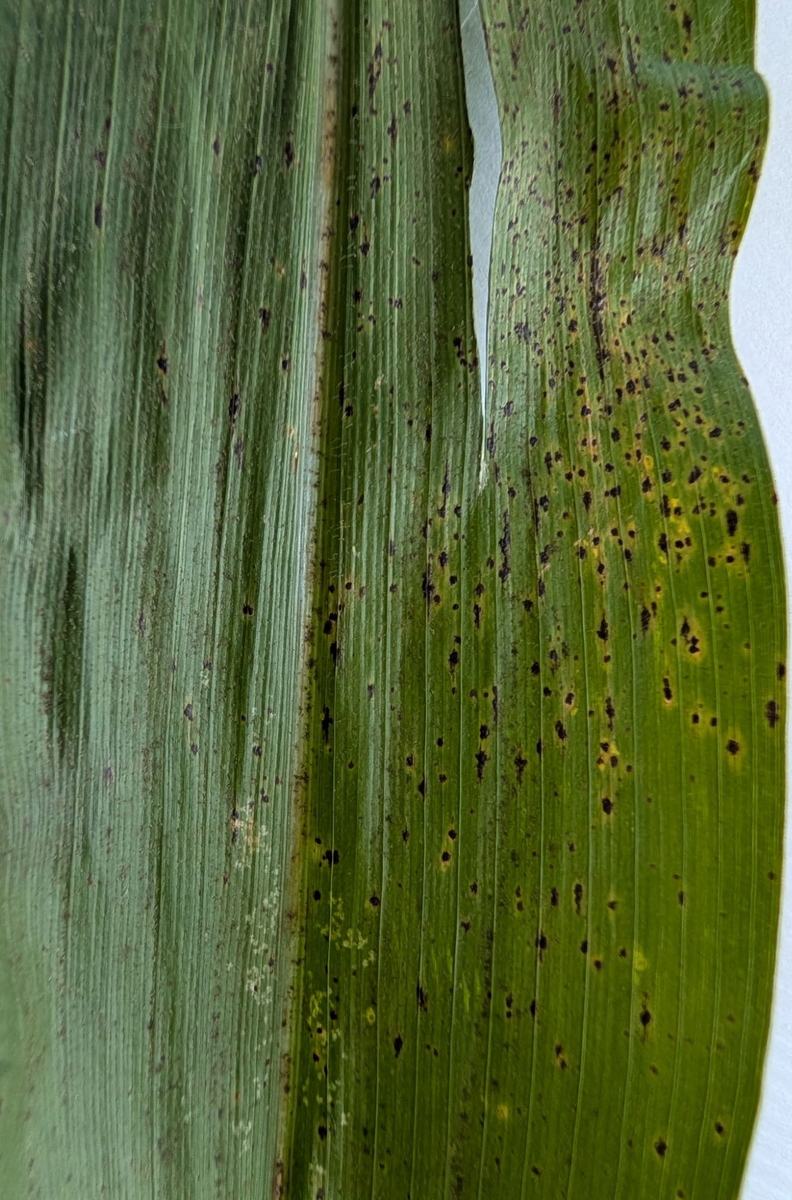
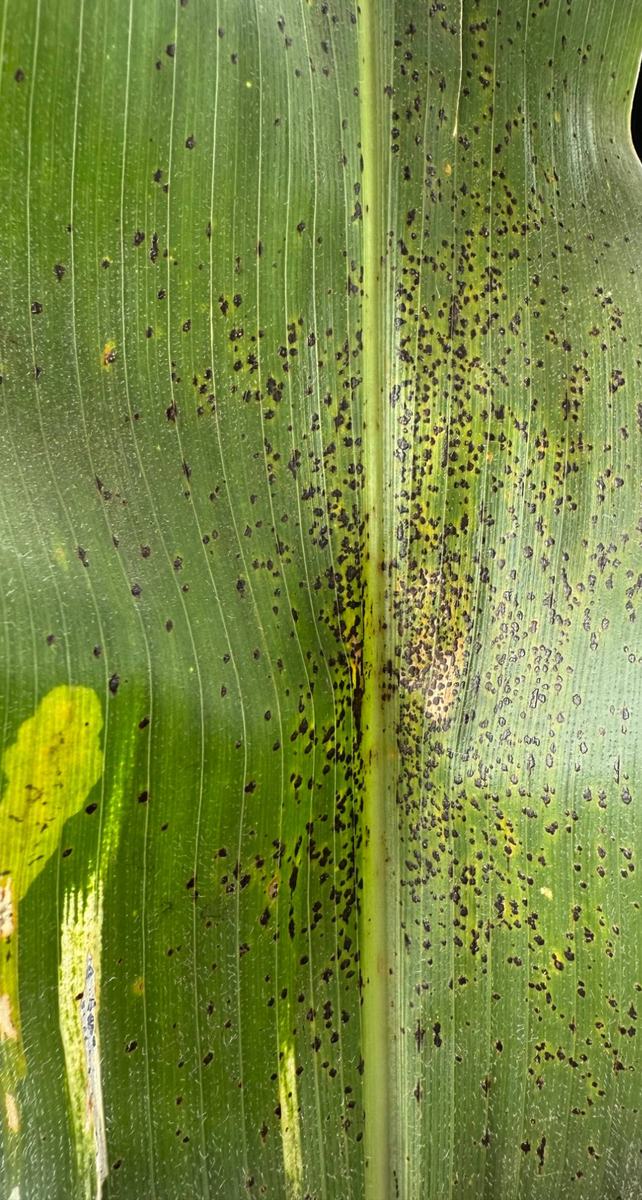
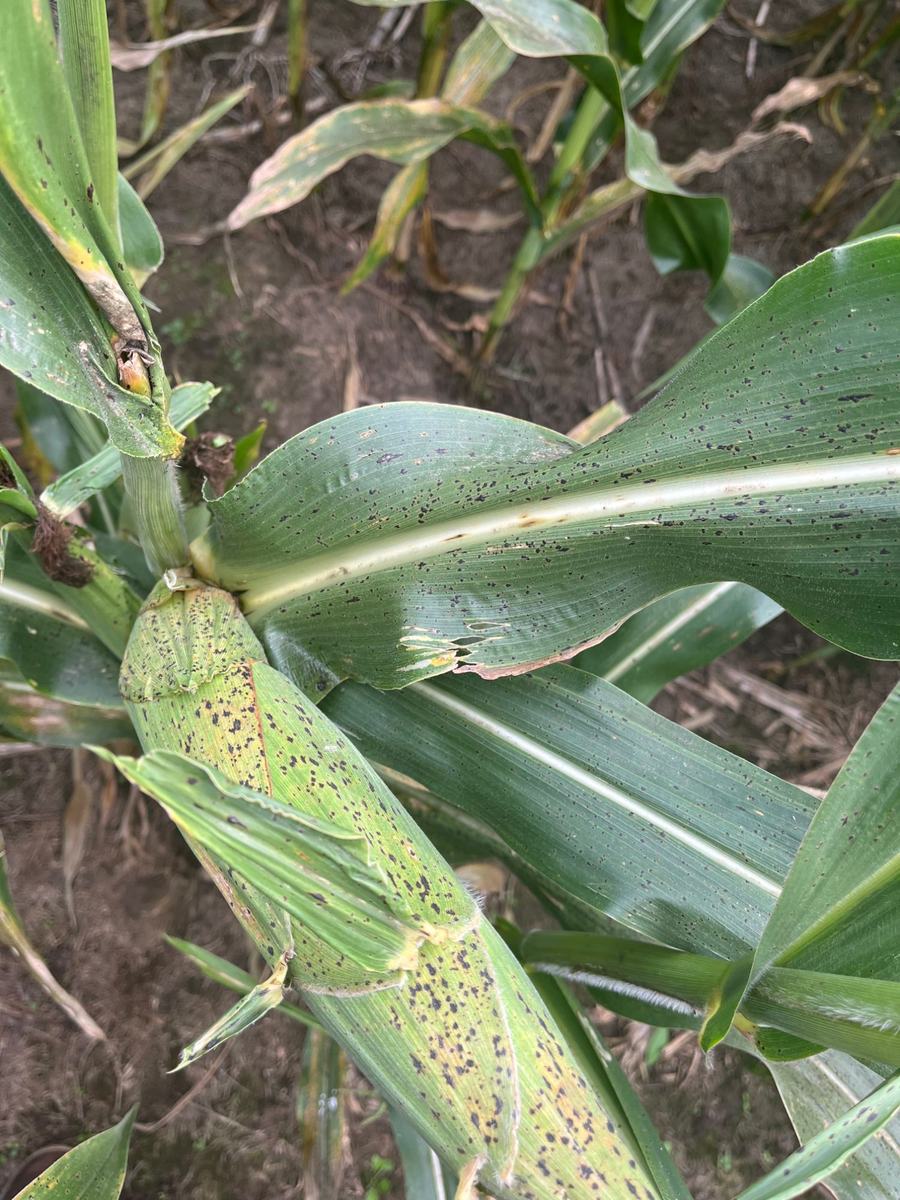
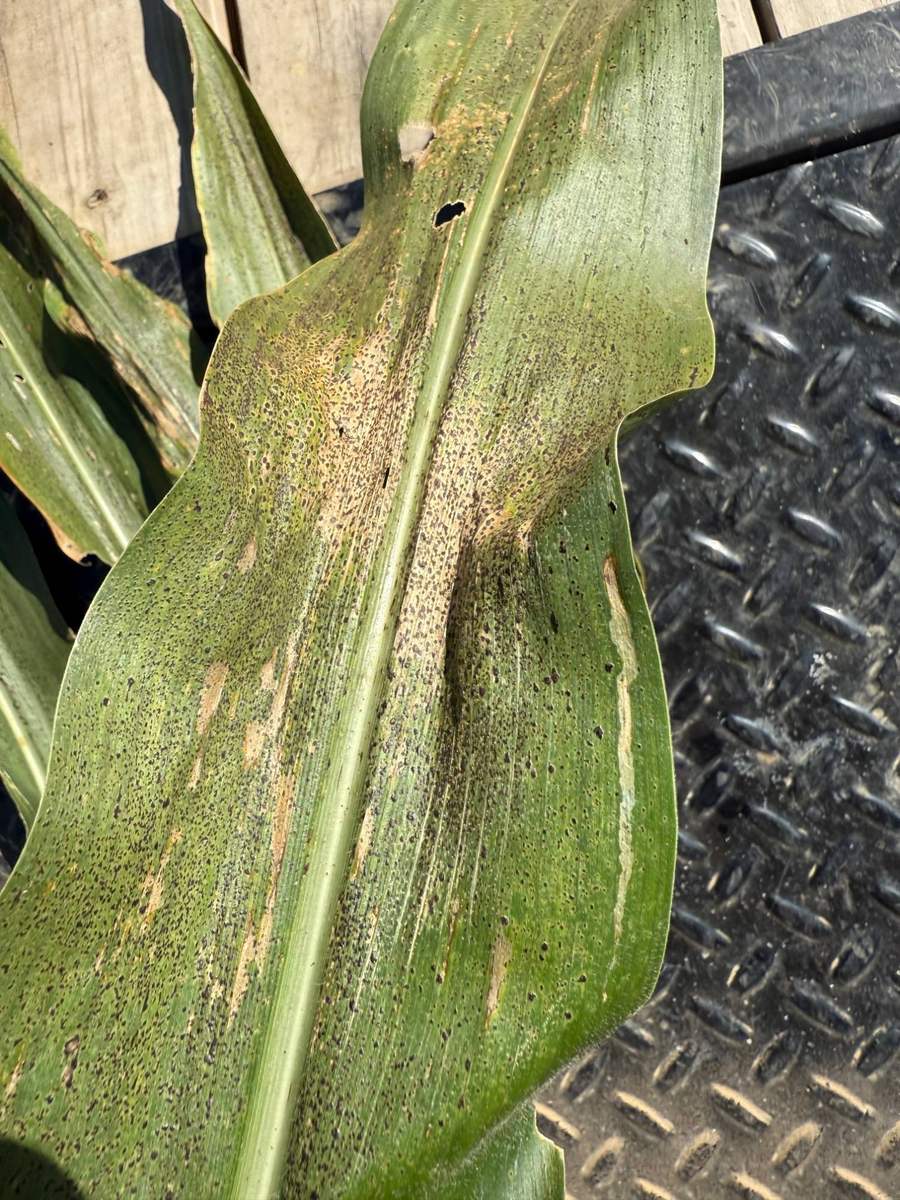
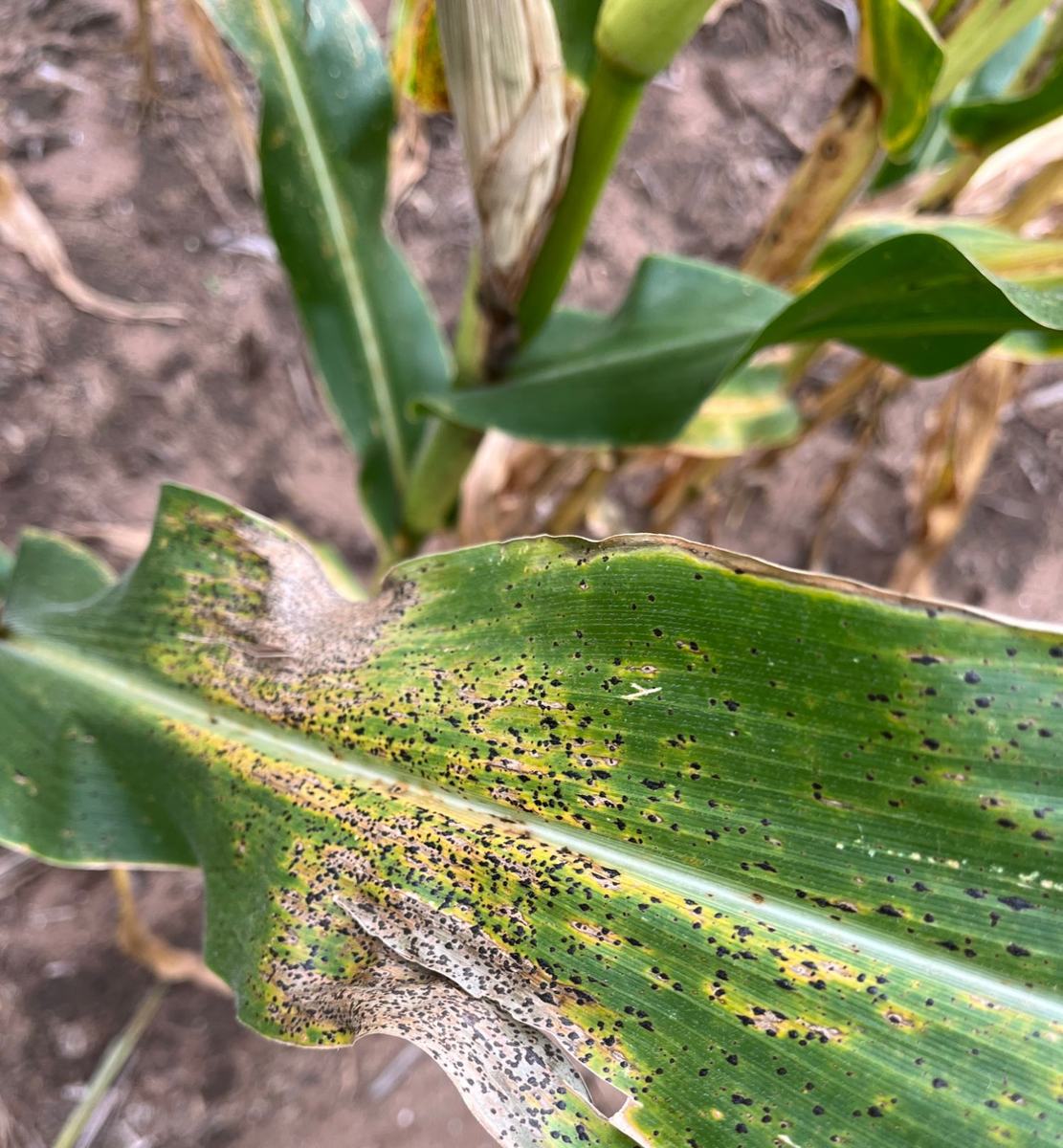
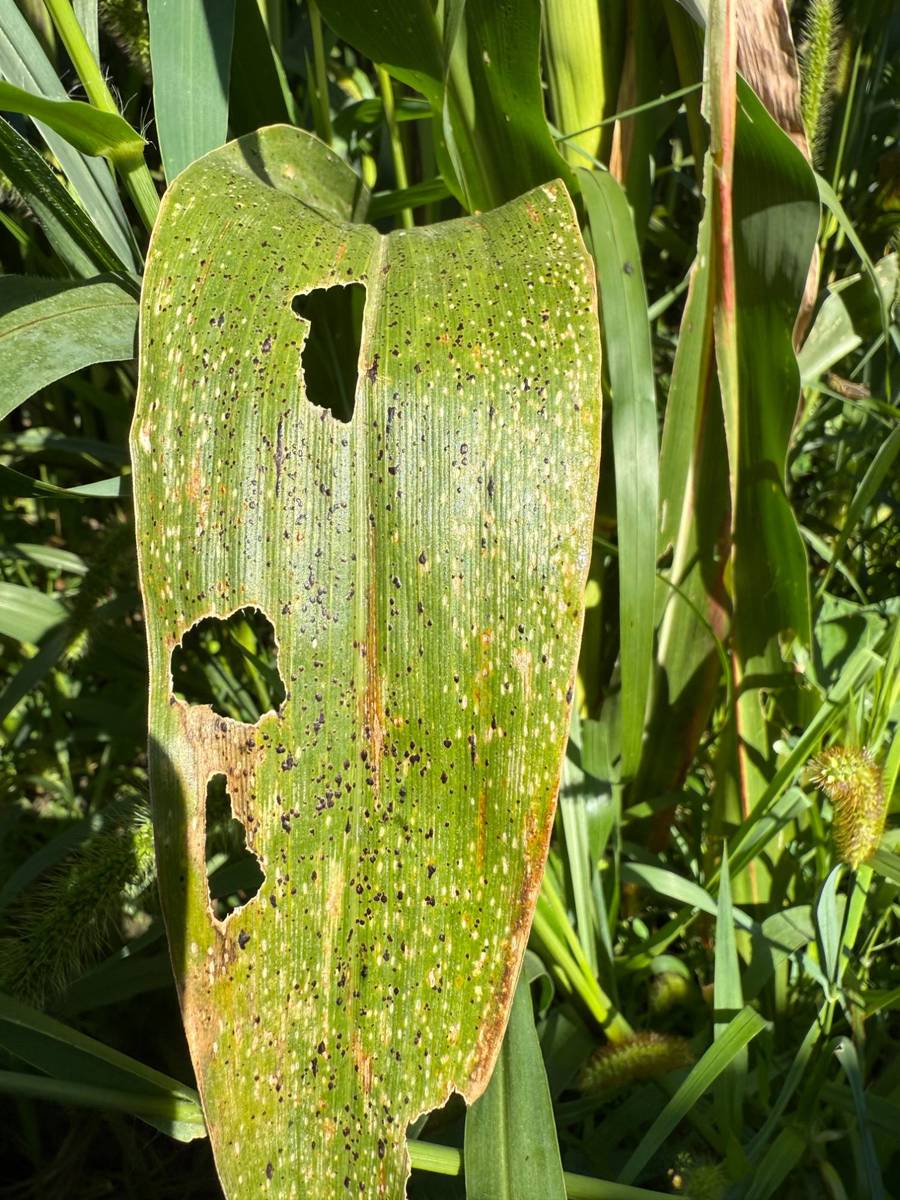
Photos: AGSIST. Tap a photo for the full size.
Look for small, raised black spots embedded in the leaf, often on both sides. Run a thumb over them: they feel bumpy and do not rub off. Some spots get a tan or yellow halo (a fisheye), but a fisheye is not needed to call it tar spot. Check lower leaves, the ear leaf and the upper canopy.
Look-alikes
- Insect droppings sit on top of the leaf and wipe off with a wet thumb. Tar spot does not.
- Rust pustules break open and shed orange or brown spores. Late in the season rust can form dark spots that also stay attached, so the scrape test is not definitive.
- Physoderma brown spot is flatter and tends to run in bands across the leaf or along the midrib.
- Mold on dead tissue late in the year can look dark too. Judge on green leaf where you can.
When to send a sample to a lab
Send one when you are not sure, and always for what may be the first find in your county. Your state's university plant diagnostic lab confirms it (the National Plant Diagnostic Network lists them). Follow that lab's own instructions. Purdue's advice is to wrap leaves in newspaper, include the field, hybrid and crop stage, and ship early in the week so the sample does not sit and rot over a weekend. Do not assume testing is free this year because it was free once. Keep dated photos of both leaf sides and the field, and call it "suspected" until the lab says "confirmed".
Sources: Crop Protection Network, An Overview of Tar Spot (July 2026); University of Missouri Extension, Tar Spot of Corn (2025); NC State Extension (August 2026); Purdue, Tar Spot: What to Look for in Corn (June 2025).
Scouting: when and how
Start before tassel. Start earlier in fields that had tar spot before, fields with infected corn residue nearby, and low, foggy, river-bottom or irrigated ground that stays humid. Early finds happen: Purdue reported tar spot on corn as early as V3 to V5 in 2025. That shows it can show up early. It does not show that an early spray pays.
A routine that keeps your notes comparable week to week (our suggestion, not a research threshold):
- Once a week through the risk period, more often when it is spreading near you.
- Walk to five spots well inside the field and look at ten plants at each. Check a wet or low spot too, but write it down on its own.
- Look at lower, ear and upper leaves, both sides. Note how many plants have it and roughly how much of the ear leaf is covered.
- Write down the date, crop stage, hybrid, any spray and the weather. Walk the same route next time.
Fifty plants is a way to keep records, not a spray trigger. We found no validated tar spot spray threshold to give you.
Weather risk: a scouting aid, not a diagnosis
The Crop Protection Network runs a Crop Disease Forecasting tool that took over from the retired Tarspotter app in 2025. It updates daily and gives a seven-day tar spot risk for your location from weather data and university-built models (Crop Protection Network, July 21, 2025).
Read a high risk day as "go look", not "go spray". The models were built from 588 field observations in eight states from 2018 to 2022, and what they predict is the chance of disease increasing, not yield loss (Crop Protection Network, Tar Spot Prediction in Corn: The Weather Matters, December 2023). A weather station's humidity is not the wetness inside your canopy. Older advice pointed to cool, humid stretches with long wet-leaf periods; newer models found it is not as simple as "wetter is always worse". Nothing reliable forecasts a field's tar spot months ahead.
When a fungicide decision matters
Hybrid first. Hybrids differ a lot in how tar spot builds on them. A less susceptible hybrid plus a well-timed fungicide where pressure justifies it is the program university guidance supports. Seed company ratings use different scales (on some 1 is best, on others 10 is best), so do not compare scores across companies.
The window is VT to R3, tassel through milk. One timely pass in that window is often the starting program. A pass much earlier can wear off before the disease gets going. At R4 the value is conditional: Indiana work found some benefit under high pressure, while Iowa State cautions that late passes control less. There is little basis for an R5 rescue spray.
Signs a pass is worth pricing: tar spot found in the field or nearby, a susceptible hybrid, a run of favorable weather, the crop at VT to R3, and plenty of green leaf left to protect.
A second pass must earn its own cost. It can be justified by green leaf still left, active disease, favorable weather, time since the first pass and room left on the label. Better disease control is not the same as more grain: in some Purdue (2024) and Wisconsin (2025) trials, fungicide held tar spot down while the yield gains were too small to call real. Judge a second pass against one pass, never against untreated corn.
Rotate modes of action and stay inside the label's seasonal limits. Two different brand names can carry the same active groups.
Sources: Crop Protection Network, Fungicide Application Reminders to Optimize Management of Tar Spot (June 2024) and Will a Second Fungicide Be Worth the Cost for Tar Spot Management? (August 2021); Crop Protection Network, Multi-State Fungicide Efficacy Trials (September 2024); Iowa State University, Should I apply a late season fungicide for tar spot? (2022); Purdue, 2024 Applied Research in Field Crop Pathology for Indiana (March 2025); University of Wisconsin-Madison, 2025 Fungicide Test Summary (January 2026).
Spray break-even calculator
Second pass: enter the cost of the second pass alone. The answer is what it has to add above one pass.
Product: your dealer's price for the rate on the label. Application: what you pay to have it put on.
Loading a corn price. You can type your own.
Optional: run-down and your own risk guess
Wheel tracks and run-down from a ground rig cost bushels too; put your own estimate in. The odds and bushels saved are your guesses. Nobody has a validated way to turn a weather risk score into those numbers, and this page does not try.
Example: a $32 an acre pass at $4 corn needs 8 bushels an acre to break even.
This is arithmetic, not a promise that a spray will save those bushels. No trial set gives a dependable chance that a pass pays in your field.
Break-even at a glance
| Cost of the pass | $3.50 corn | $4.00 | $4.50 | $5.00 |
|---|---|---|---|---|
| $20 an acre | 5.7 | 5.0 | 4.4 | 4.0 |
| $30 an acre | 8.6 | 7.5 | 6.7 | 6.0 |
| $40 an acre | 11.4 | 10.0 | 8.9 | 8.0 |
| $50 an acre | 14.3 | 12.5 | 11.1 | 10.0 |
| $60 an acre | 17.1 | 15.0 | 13.3 | 12.0 |
Bushels an acre = cost an acre / corn price. Arithmetic on round numbers, not prices we found or yields anyone measured.
Product efficacy ratings
The Corn Disease Working Group rates how well each fungicide controls tar spot, from trials across universities. The ratings are about disease control, not bushels or profit, and the table is not a full list of every product sold. The current edition is February 2026 (Crop Protection Network, Fungicide Efficacy for Control of Corn Foliar Diseases). Numbers in parentheses are the products' FRAC groups, for rotating modes of action.
| Tar spot rating | Products |
|---|---|
| Very good | Delaro Complete (3+7+11), Revytek (3+7+11), Veltyma (3+11) |
| Good to very good | Adastrio* (3+7+11), Aproach Prima (3+11), Delaro (3+11), Forcivo* (3+7+11), Fortix* (3+11), Headline AMP* (3+11), Miravis Neo (3+7+11), Preemptor* (3+11), Topguard EQ* (3+11), Trivapro (3+7+11) |
| Good | Affiance* (3+11), Aproach* (11), Lucento (3+7), Quilt Xcel (3+11) |
| Poor | Xyway 3D* (3), Xyway LFR* (3) |
| Labeled, too little data to rate | Domark (3), Priaxor* (7+11) |
| Not labeled for tar spot | Folicur, Headline, Proline, Quadris, Stratego YLD, Tilt |
* The table's footnote: tar spot use comes through a supplemental (2(ee)) label and efficacy data are limited. Supplemental labels vary by state. Rates, stage cutoffs and days to harvest differ by product and sometimes run higher for tar spot than the general corn rate. Read the current label before you buy.
Harvest, standability and silage
Severe leaf loss is a reason to check stalks before harvest. Purdue's method: push or pinch-test 20 plants at each of five spots, and move a field up the harvest list when 10% or more fail (Purdue, Are Your Fields at Risk for Lodging?, September 2021). That is a harvest rule, not a tar spot severity-to-lodging formula. Stalk rot in those fields is not tar spot infecting the stalk; tar spot is a leaf disease.
Silage: a dying canopy can dry the whole plant down faster than the kernels suggest. Test whole-plant moisture instead of going by the calendar or the milk line alone. Do not assume tar spot makes a mycotoxin; if a feed test finds one such as DON, look for the ear rot that makes it and test the feed.
Crop insurance: disease is an insured cause of loss, subject to the policy's terms, including what counts as adequate control (USDA Risk Management Agency coarse grains fact sheet, November 2021). Tell your agent promptly, usually within 72 hours of finding the damage, and before you chop grain-insured corn for silage or give up on a field (USDA Risk Management Agency guidance). Keep dated photos, lab results, scouting notes and spray records.
Myths against the evidence
- "Tar spot is manganese residue, a nutrient problem."
- Under the microscope the black spots are fungal structures (Crop Protection Network, Mythbusting Tar Spot, 2025).
- "Sugar, molasses or a nutrient spray will cure it."
- The evidence does not support a cure from any of them (same source).
- "No fisheye halo, so it is not tar spot."
- The halo may show up or may not. The raised black spots that do not rub off are the sign that counts.
- "Nobody has reported it in my county, so I am safe."
- The map shows where someone found and reported it, not where it is absent.
- "More rain always means more tar spot."
- Weather models built from field data found the link is more complicated than that (Webster and others, 2023).
- "The best-rated product will yield the most."
- The ratings measure disease control. Bushels depend on pressure, timing, hybrid and weather after the pass.
- "Two passes are always better than one."
- More disease control does not prove more profit. A second pass has to pay its own cost over one pass.
- "Drones always get better coverage."
- Coverage depends on the setup, carrier volume and the crop. Kentucky and Indiana trials (2024) did not show any one way of applying winning everywhere.
Questions
Where is tar spot now?
Tar spot was first confirmed in the United States in 2015, in Indiana and Illinois. It has since spread through the Corn Belt and beyond: North Dakota State University found it in nine North Dakota counties in 2024, and NC State Extension confirmed North Carolina's first case, in Randolph County, in 2026. The Crop Protection Network keeps the county map of confirmed finds.
What does tar spot look like?
Small, raised black spots that sit in the leaf tissue and feel bumpy, like flecks of tar. They do not rub off. A tan or yellow halo (a fisheye) may show around some spots, but it does not have to be there. Look at both sides of the lower, ear and upper leaves.
How do I tell tar spot from rust or insect droppings?
Insect droppings wipe off with a wet thumb; tar spot does not. Rust pustules break open and shed orange or brown spores, but late in the season rust can form dark spots that also stay put, so the scrape test is not the final word. If you are not sure, or it is the first find in your county, send a sample to your state's plant diagnostic lab.
When should I spray fungicide for tar spot?
University guidance puts the main decision from tassel (VT) through milk (R3), when tar spot is in the field or close by, the weather favors it and the hybrid is susceptible. A pass much earlier can wear off before the disease period. Later passes have less yield left to protect. Check the label for rates, crop stage limits and days to harvest.
Does a second fungicide pass for tar spot pay?
Only if the extra bushels it adds over one pass cover its own cost. Better disease control is not the same as more grain: in recent Purdue (2024) and Wisconsin (2025) trials, fungicide held tar spot down while the yield gains were too small to call real. Compare a second pass with one pass, not with untreated corn. The calculator on this page does that arithmetic.
How many bushels does a fungicide pass need to break even?
Divide the cost of the pass by your corn price. A $32 an acre pass (product plus application) at $4 corn needs 8 bushels an acre. Add any bushels the trip itself knocks down. That is arithmetic, not a promise the pass will save that much.
Does tar spot make mycotoxins in corn silage?
Do not assume it does. The Crop Protection Network's tar spot overview warns about fast drydown, not a tar spot toxin. Dead leaves can make the plant dry down fast, so check whole-plant moisture before you chop. If a feed test finds a toxin such as DON, look for the ear rot that makes it.
Sources
Named here with their dates, not linked. Search the title to find each one.
- Crop Protection Network (Telenko and others), An Overview of Tar Spot, July 9, 2026.
- Ruhl and others, First report of tar spot on corn caused by Phyllachora maydis in the United States, 2016.
- University of Maryland Extension, Preparing for Tar Spot of Corn in 2023 (updated October 2024).
- North Dakota State University, Crop and Pest Report: Tar Spot of Corn Found in North Dakota, October 10, 2024.
- NC State Extension, First Report of Tar Spot of Corn Confirmed in North Carolina, August 31, 2026.
- Crop Protection Network, Corn Disease Loss Estimates from the United States and Ontario, Canada: 2021, 2023, 2024 and 2025 editions.
- University of Missouri Extension, Tar Spot of Corn (G4156), 2025.
- Purdue University (Telenko), Tar Spot: What to Look for in Corn and Making an Informed Decision on Fungicide Application, June 2025.
- Crop Protection Network, Crop Disease Forecasting Tool Replaces Retired Apps, July 21, 2025.
- Crop Protection Network (Webster and others), Tar Spot Prediction in Corn: The Weather Matters, December 18, 2023; Webster and others, Scientific Reports, 2023.
- Crop Protection Network, Fungicide Application Reminders to Optimize Management of Tar Spot and Return on Investment in Corn, June 14, 2024.
- Crop Protection Network, Will a Second Fungicide Be Worth the Cost for Tar Spot Management?, August 19, 2021.
- Crop Protection Network (Goodnight and others), Multi-State Fungicide Efficacy Trials to Manage Tar Spot, September 4, 2024.
- Iowa State University, Should I apply a late season fungicide for tar spot?, 2022.
- Corn Disease Working Group and Crop Protection Network, Fungicide Efficacy for Control of Corn Foliar Diseases, February 2026.
- Purdue University, 2024 Applied Research in Field Crop Pathology for Indiana, March 2025.
- University of Wisconsin-Madison, 2025 Fungicide Test Summary, January 2026.
- University of Kentucky, 2024 Corn Research Reports (drone application).
- Purdue University, Are Your Fields at Risk for Lodging?, September 2021.
- Crop Protection Network, Mythbusting Tar Spot: Separating Fact from Fiction, 2025.
- USDA Risk Management Agency, Coarse Grains fact sheet (November 2021) and crop insurance guidance on damaged crops.
- Calculator prices: CBOT corn futures (delayed) and each state's median elevator basis from our basis page; custom spraying rates from state custom rate surveys, as on our custom rates page.